
Report
Beyond the Classroom: 2026 Education Expense Trends Revealed
What 65,000 expense claims reveal about what it costs to run education, and what's really happening beyond the classroom.

Loading the form…
What expense claims reveal about modern education
Education institutions are responsible for far more than delivering lessons and their expense claims reveal just how much happens beyond the classroom. We explore the trends, behaviours, and insights contained in the claims, which cover all of the education sector—from schools, colleges, universities, and even teachers’ unions.
- 65,000 expense claims submitted through Capture Expense
- 12 months of claims, July 2025 to June 2026
- £1.25 million in spend across the top ten categories alone
If you’re a school business manager, bursar, finance manager, or CFO, understanding expense trends and spend behaviour can help you improve compliance, streamline processes, and create a better experience for both your staff and finance team.
Beyond the school gates
Travel dominates education expense claims, revealing just how far learning now extends beyond the school gates.
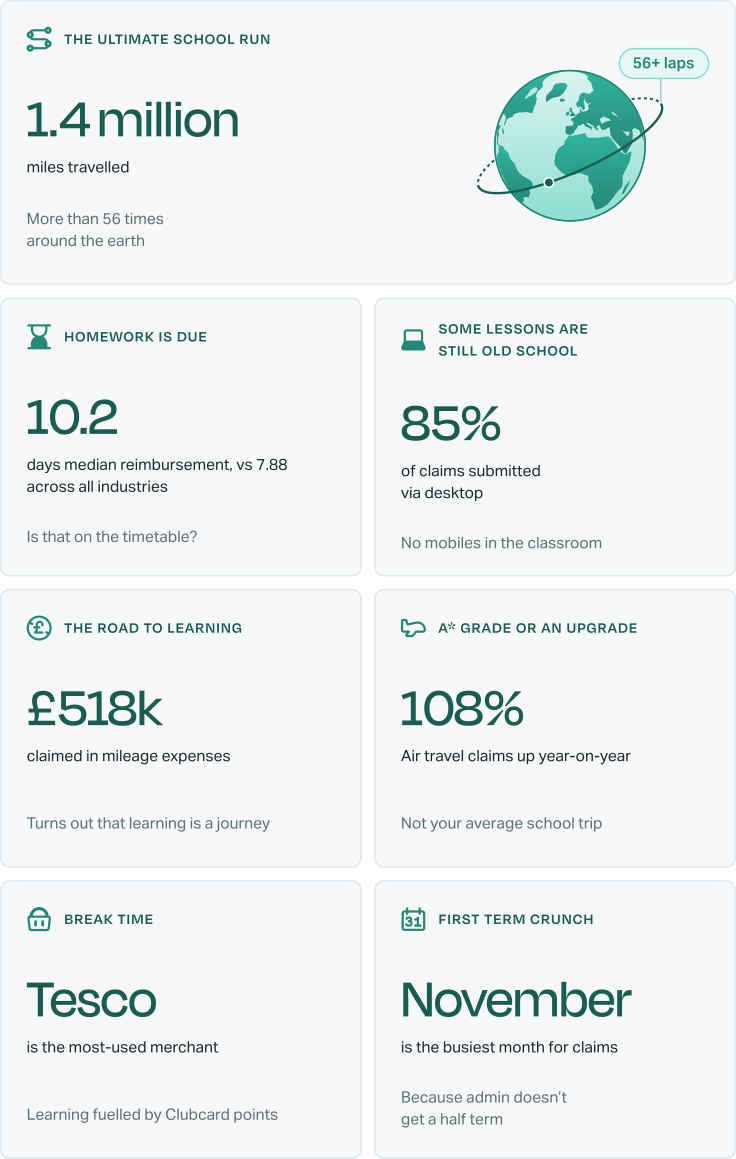
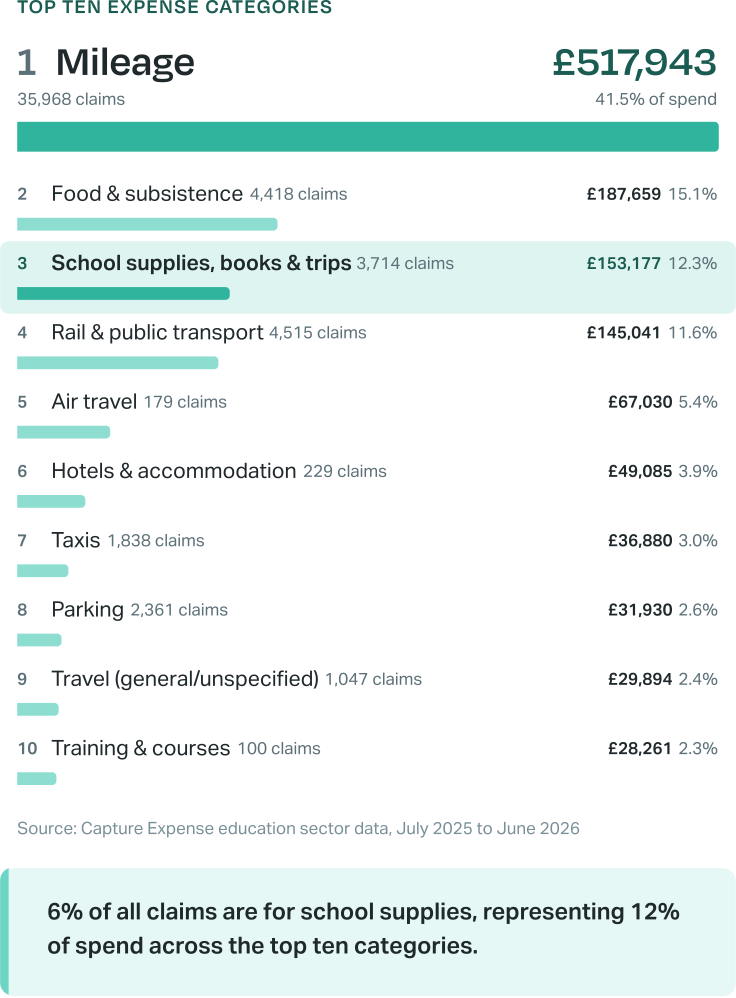
Educators clocked up 1.4 million miles over the course of the year. Mileage remains the biggest expense category, costing education institutions more than £500,000. When you combine that with all travel related expenses, the cost rises to £878,000. That’s a lot of unpredictable spend from already tight budgets that are often based on a fixed forecast.
Air travel is one of the fastest growing expenses: claims are up 108% since last year. While the number of claims is relatively small, air travel cost over £67,000.
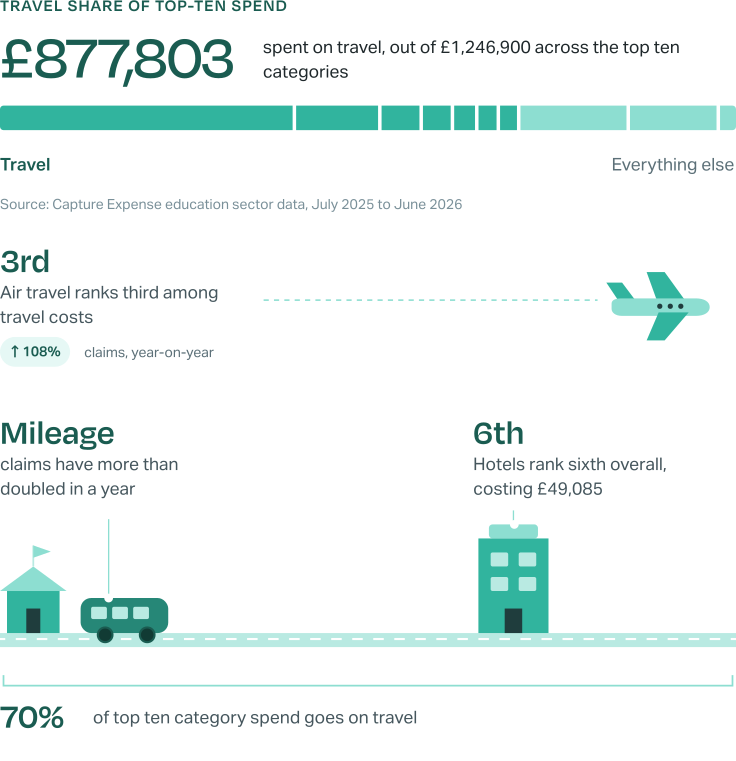
Travel-related expenses appear in seven of the top ten spending categories.
If you’re responsible for managing education budgets, the growth in travel spending creates a challenge. For a regulated sector on tight budgets, and with complex spend allocation, ad hoc claims for air travel could be a focus area for finance teams to make cuts.
The unofficial school supply cupboard
Expense claims suggest many educators are choosing convenience and speed over formal purchasing processes.
Over £153,000 was spent on supplies, books, and trips: number three in the top spending categories. Supermarkets are the supply cupboard of choice, with Tesco, Asda, and Sainsbury’s featuring in the top five merchants visited.
Top five merchants used by education organisations:
- Tesco
- Trainline
- Asda
- Sainsbury’s
- Marks & Spencer
One big ticket item that didn’t make it into the top ten by value but did by volume of claims is equipment and hardware costs. You’d expect these purchases to be made by a central purchaser rather than expensed, which begs the question, are educators adhering to purchase rules?
The data suggests that they’re not always being followed. When purchases happen outside of approved routes, audit trails become harder to maintain and overspending more likely. All of this represents a hidden cost for your finance team: time spent reviewing and delaying payment while they’re matched to a budget, and the impact on cash flow.
Has mobile missed the register?
Despite growing investment in software and digital tools, expense claims are reliant on traditional processes.
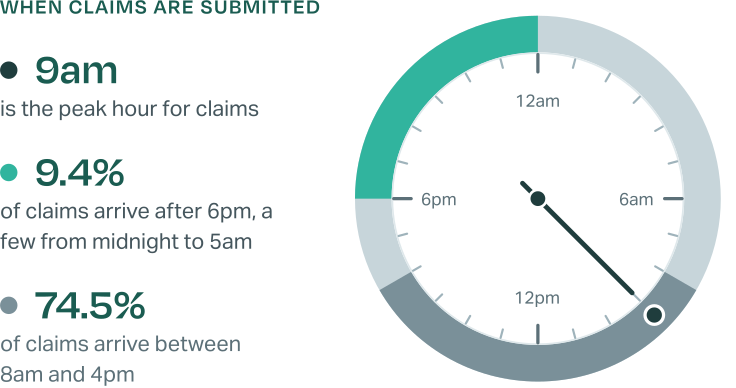
85% of all claims are still submitted using a desktop computer rather than on a mobile that can capture and upload digital receipts in seconds. With 74.5% of claims submitted between 8am and 4pm, much of this admin appears to be completed during the working day, rather than on the move. Only 15% of claims were submitted via mobile and just 44% included a digital receipt.
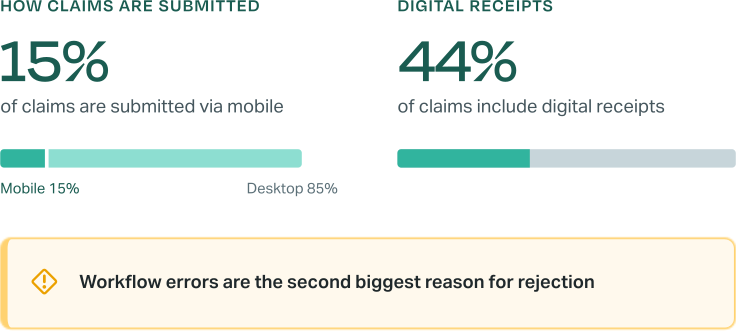
For finance teams, that creates extra work. It means more chasing, longer payment times and an impact on your cash flows and reconciliation. The good news is that the volume of expenses being rejected is relatively low, and workflow errors are the second biggest reason for rejection.
The data suggests that mobile-first technology does not necessarily result in mobile-first behaviour. While education organisations are adopting digital tools, there are still opportunities to reduce admin and improve efficiency and automation.
The hidden cost of teaching
Educators and staff regularly pay for work related items upfront before being reimbursed. The typical education expense takes 10.2 days to reimburse compared with 7.88 days across all industries. That’s 29% longer.
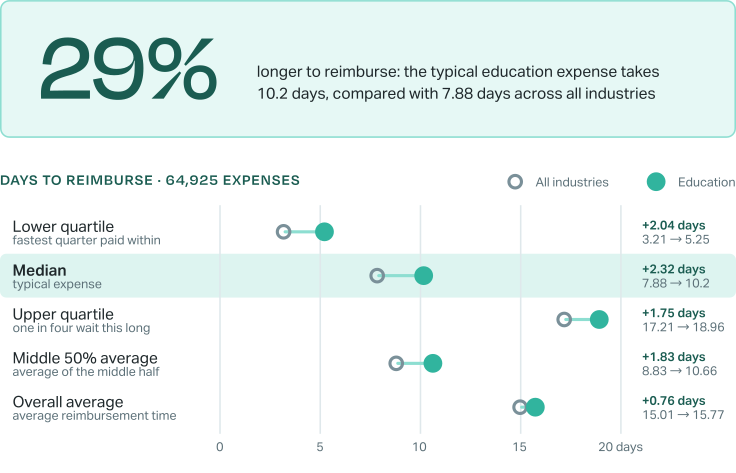
The gap starts early. The fastest quarter of education claims are paid within 5.25 days while the fastest quarter across all industries are paid within 3.21 days. At the other end one in four education claims waits almost 19 days or longer against just over 17 days for all industries.
Delivering prompt payment helps more than your staff’s pockets. Faster reimbursement times can help your visibility of spending and improve reconciliation so that budgets and forecasts are closely aligned and accurate.
Busiest months and day
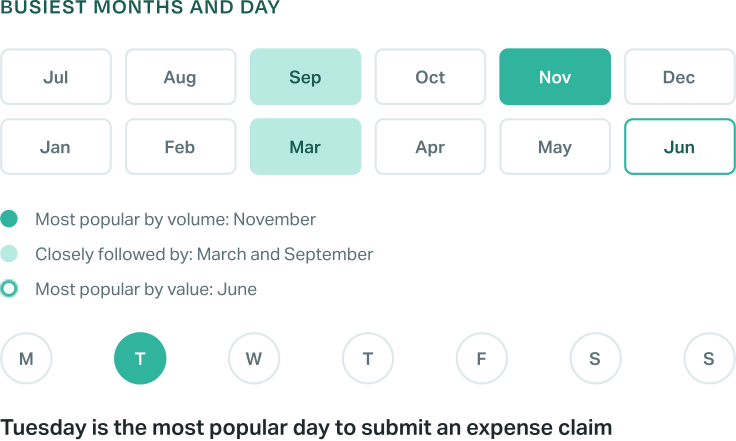
November is the most popular month for submitting an expense, closely followed by March and September. It’s surprising, since you’d expect July and September to be the busiest months as budgets are closed and opened for the academic year. But there may be simple explanations: the autumn term is peak time for teacher recruitment, education conferences, and CIPD programmes. Tuesday is the most popular day to submit an expense claim.
It takes a village
Schools are so much more than simply classrooms, they’re community hubs.
Spending extends into pupil wellbeing, enrichment activities, exam breakfasts, festive celebrations and wider school experiences, highlighting the role education plays at the heart of their communities. Food and subsistence claims came to £188k, and breakfast is among the most expensed food categories.
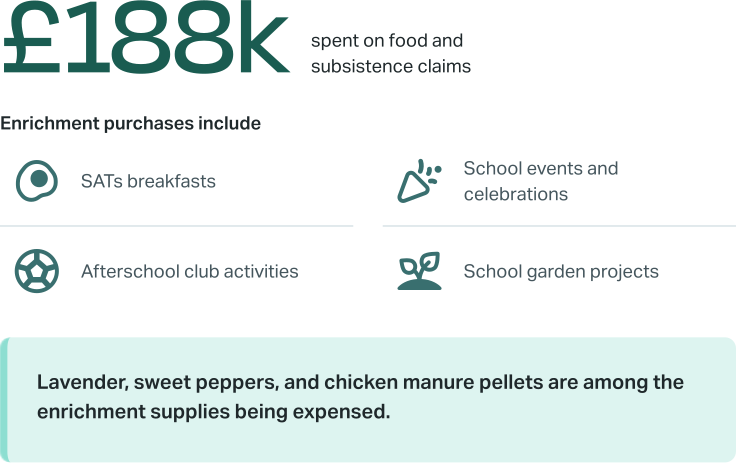
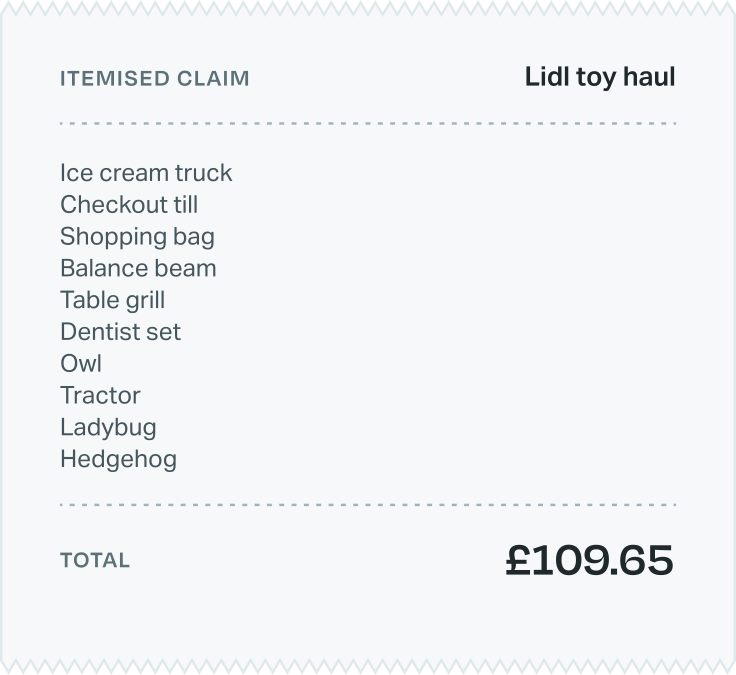
One claim included a £109.65 Lidl toy haul. The itemised claim included ‘ice cream truck, checkout till, shopping bag, balance beam, table grill, dentist set, owl, tractor, ladybug, hedgehog’. Clearly an early-years equipment shopping trip to support children’s enrichment and learning through play.
This all begs the question, should supplies be bought centrally to stop the impact on teaching staff’s own wallets? Central purchasing may help you to improve control and forecasting, but there will always be situations where small purchases need to be made quickly. The challenge is finding the balance between flexibility and oversight.
Show and tell
The expense claims that made us smile. These claims may seem unusual, but together they reveal the creativity, care and practical support that sit behind modern education.
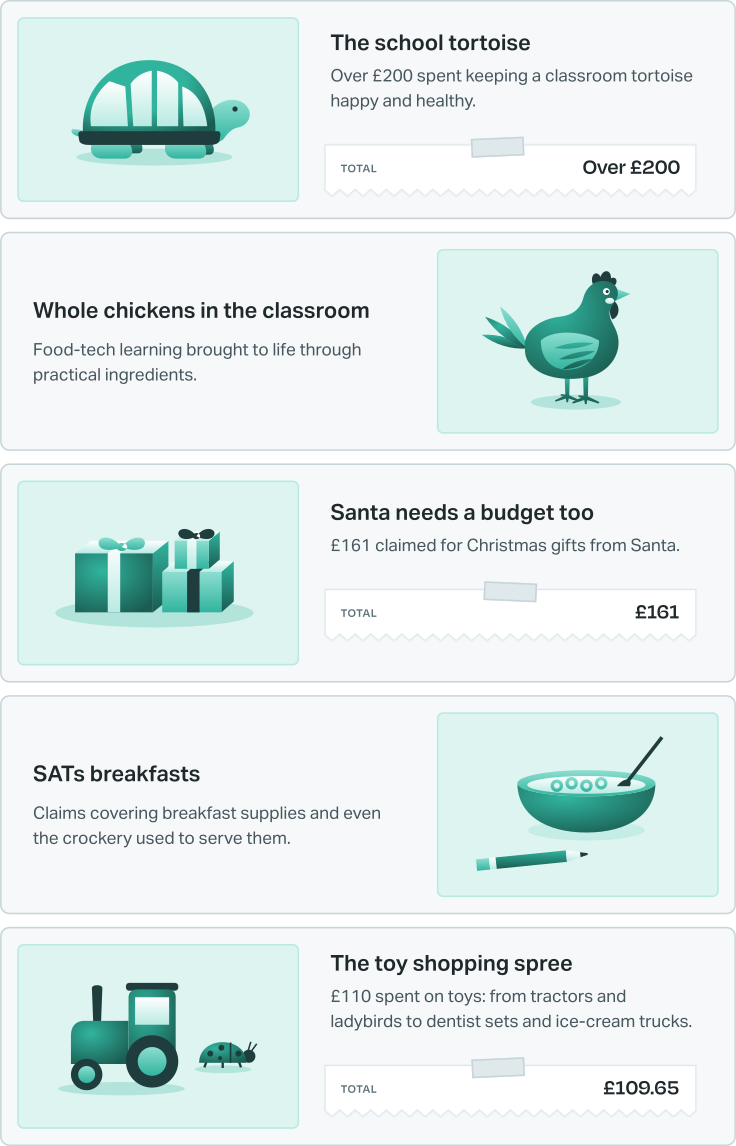
- The school tortoise: over £200 spent keeping a classroom tortoise happy and healthy
- Santa needs a budget too: £161 claimed for Christmas gifts from Santa
- The toy shopping spree: £110 spent on toys, from tractors and ladybirds to dentist sets and ice-cream trucks
- Whole chickens in the classroom: food-tech learning brought to life through practical ingredients
- SATs breakfasts: claims covering breakfast supplies and even the crockery used to serve them
Every education organisation is different
What works for a large multi-academy trust might not be appropriate for a nursery school or university. Capture Expense helps you simplify expense management, reduce admin, and improve visibility of spending. Its mobile-first expense management software automates expense reports, approvals, analytics, and compliance.
More guides
 Report
Captured: 2026 Expense Trends Revealed
Insights from nearly one million expense claims on how UK organisations are moving from expense administration to expense intelligence.
Get the report Infographic
2025 Expense Trends Infographic
This infographic is built by real expense data from 460+ businesses and 371,000 claims, revealing the habits, hotspots, and clues behind spend.
Get the infographic Guide
Expenses Software for Construction
Capture Expense is the simple yet sophisticated expense software designed for the unique challenges faced by construction businesses.
Get the guideSee how simple expenses can be
Book a 30 minute demo with one of our team, or start a free trial and explore a ready-made workspace with your own data.
Rated 4.9 out of 5 on Capterra No credit card for the trial Reply within one working day